

F1 vs. F1B Goldendoodles: Understanding the Key Differences
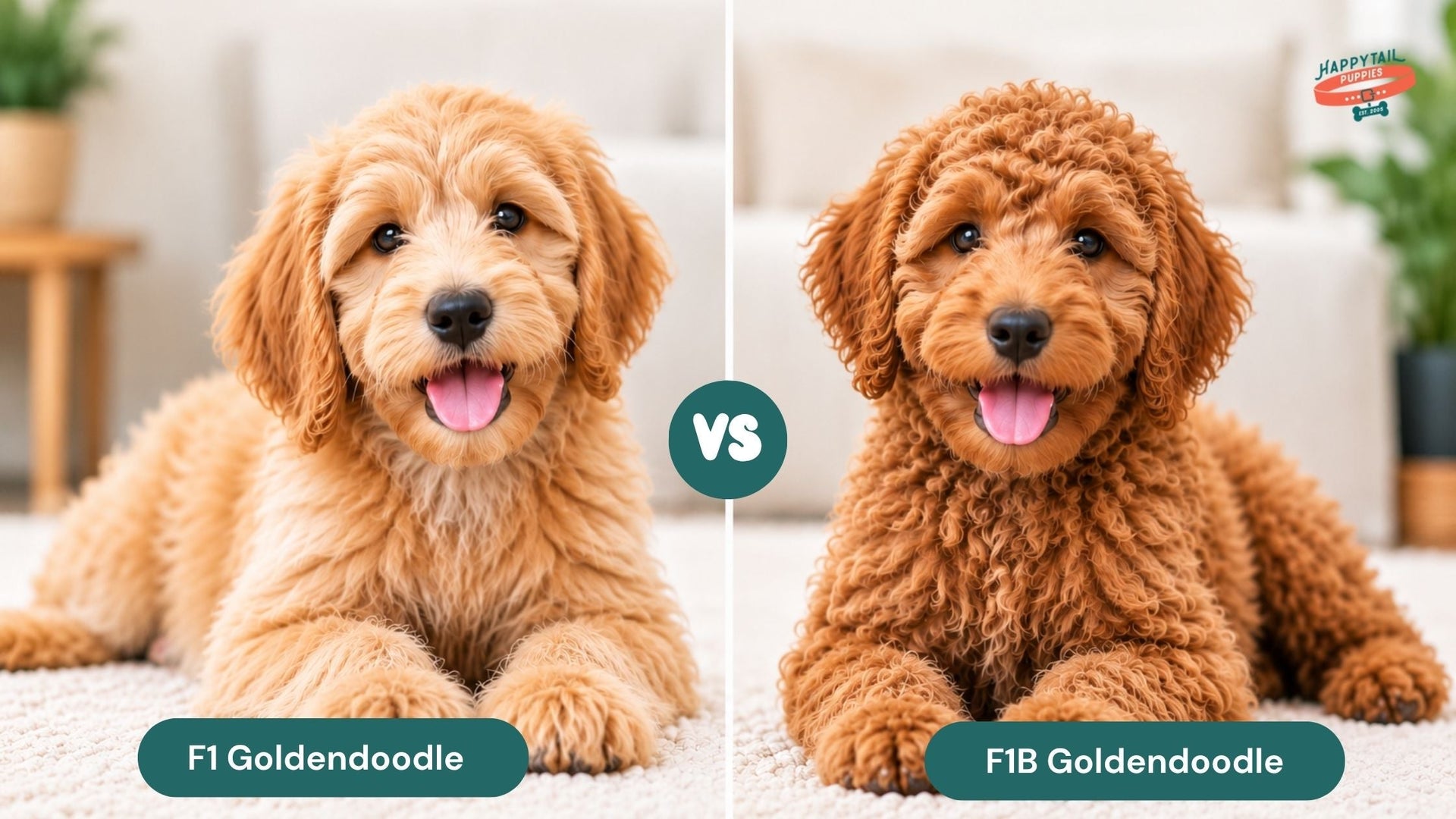
Choosing between F1 and F1B Goldendoodles starts with understanding what sets them apart. Compare their genetics, coat types, grooming needs, size, and temperament to know what to expect from each generation before choosing your puppy.
⚡Quick Answer
The main difference between F1 and F1B Goldendoodles is genetics, since an F1 is half Golden Retriever and half Poodle. An F1B is about 75% Poodle because it was bred back to a Poodle. F1B puppies are well-known for their curlier coats. However, coat, size, and personality differ from puppy to puppy.
Goldendoodles are mainly categorized into generations, and each one tells you how a puppy was bred and how much Golden Retriever and Poodle traits it has. The letter “F” shows the puppy was bred from a planned cross, and the number or letter after it indicates the type of cross.
A puppy’s parents matter more than its label. This means two puppies from the same generation can look and act differently. So, understanding each label helps you ask better questions and set realistic expectations when comparing F1 and F1B Goldendoodle puppies.
What Is an F1 Goldendoodle?
This is mainly the first generation that results from mating a purebred Golden Retriever with a purebred Poodle. Since each parent passes on about half of their genes, an F1 Goldendoodle is typically around 50% Golden Retriever and 50% Poodle.
Most F1 puppies have a wavy, soft coat and a slightly shaggy look, though some have straighter or curlier hair. Most are friendly, like a Golden Retriever, with a Poodle's intelligence and playful side.
So, imagine a family with younger kids who want a cuddle-friendly dog for daily walks and games. In these cases, most F1 puppies fit the picture well, as they are easy to adore.
Common traits include:
- Softer, wavier, or shaggy coat
- Friendly, social, and people-friendly in nature
- Intelligent and always eager to please
- Size relies on the parents
What Is an F1B Goldendoodle?
The letter “B” stands for backcross. This means breeders breed an F1 puppy back to a Poodle. This gives an F1B Goldendoodle about 75% of Poodle traits and 25% of Golden Retriever traits.
Because of these extra Poodle genes, F1B puppies often have curlier coats and may be a bit alert or active. Some puppies might still have wavier coats, so it’s always best to check each pup individually.
If you and your family love a curly, teddy-bear look and don't mind brushing them a couple of times each week, most F1B puppies can fit that household well.
Primary characteristics of F1B Goldendoodles are:
- Tight and curly coats
- Fuller eyebrows and beard
- Alert, playful and energetic in nature
- Traits may vary in each puppy
F1 vs. F1B Goldendoodle: Key Differences
Here’s a quick side-by-side comparison of the two generations.
| Features | F1 Goldendoodle | F1B Goldendoodle |
|---|---|---|
| Genetics | About 50% Golden, 50% Poodle | About 75% Poodle, 25% Golden |
| Coat type | Often wavy, sometimes straight | Often wavy to curly |
| Appearance | Shaggy, relaxed look | Curly, fuller face |
| Shedding | Light to moderate | Usually light |
| Grooming needs | Regular brushing | Frequent brushing and trims |
| Temperament | Friendly and laid-back | Playful and alert |
| Trainability | Smart, eager to please | Smart, quick learners |
| Size | Depends on parents | Depends on parents |
| Energy | Moderate to high | Moderate to high |
These are typical patterns, since a puppy can inherit more traits from one parent than the other.
Coat and Appearance Differences
One of the most common things potential dog owners look at when comparing F1 and F1B Goldendoodle puppies is their coats. F1 puppies have a wavy, soft and shaggy look, while F1B puppies have fuller facial hair and tighter curls. This will make their face rounder and fluffier.
A puppy's coat type depends on a couple of genes. One gene controls how curly the coat is, and the other controls whether the dog grows facial hair. During breeding, a puppy needs the right mix of traits from both parents. Siblings can also look a bit different.
Grooming depends mainly on coat type. Tangles and mats form more easily in wavy or curly coats. So, schedule a proper brushing routine several times a week, or include regular trims. Curlier coats will often need brushing to remain smooth and comfortable.
Another common question for families planning to bring home a puppy is whether Mini Goldendoodles are hypoallergenic compared with other coat types.
Temperament and Family Suitability
Both Goldendoodle generations are friendly and social. They are perfect for households with children and other pets. F1 puppies are calmer and more loving because of their Golden Retriever parents, while F1B puppies show more of a Poodle’s smarts and high energy.
Early socialization and training can shape a puppy's adult behavior. Keep the first months of puppyhood focused on meeting new people, places, and sounds to help them feel more grounded around guests later.
Also create a routine for your puppy. A family that loves long walks or enjoys yard games can bring home either an F1 or an F1B generation. On the contrary, a quieter home is ideal for a pup bred from calm, relaxed parents. Regular physical activity and mental stimulation can keep these smart dogs happy and content throughout their lives.
If you want to know about a Mini Goldendoodle lifespan, you'll be happy to know these dogs can stay with their families for many years.
🐾 What the Latest Data Shows
According to the American Veterinary Medical Association, the United States alone has 88.9 million pet dogs. This is a significant increase from 76.8 million as reported in 2016. This suggests that average household pet ownership includes children under 17 and highlights how many families can share homes with dogs.
How to Choose Between an F1 and F1B Goldendoodle
If you’re choosing between F1 and F1B Goldendoodles, start by considering what matters most to you and your family. Then match those requirements to the puppy's parents.
Here are some questions that are worth asking yourself:
- Can you brush them often?
- How active is your family, and what activities do you like?
- What’s the size of your home?
- Do you like curly, wavy coats?
Another vital thing to ask the breeder about is health testing. Reputable breeders will show you hip, elbow, eye, and heart checks for the parent dogs. They might even share DNA test reports that suit Golden Retrievers and Poodles.
Lastly, if you can, meet the parents. Their coat, size, and behavior give you a helpful idea of what the puppy will be like, whether the paperwork says F1 or F1B.
🐾 Pro Tip
When meeting the breeder, do ask for photos of both parents as adults. Seeing their real coats and sizes will tell you more than any generation label.
Final Thoughts
Both F1 and F1B generations can make great family dogs, and the right choice depends on the coat type you want, how much grooming time you can commit, and the daily routine you can create for the dog. Also remember the differences between the two labels, meet the parents, and choose the puppy whose personality best fits your home.
Frequently Asked Questions
What is the main difference between F1 and F1B Goldendoodles?
F1 is a cross between a Golden Retriever and a Poodle. F1B means an F1 that has been bred back to a Poodle, so it has more Poodle genes.
Is an F1B Goldendoodle more Poodle than Golden Retriever?
Absolutely, it’s documented. F1B indicates 75% Poodle and 25% Golden Retriever characteristics, but individual dogs can express them as Poodle or Golden in varying degrees.
Are F1 and F1B Goldendoodles different in size?
Size isn't primarily a function of the generation, but mostly of the Poodle parent, whether toy, mini, or standard. The other parent's size also matters; ask the breeder about that parent's size, too.
Which generation requires more grooming?
F1B will have a curlier coat and will require more brushing and trimming. Wavy or curly coats also require regular maintenance. Brush each puppy regularly to prevent matting.
Do F1 and F1B Goldendoodles have different temperaments?
F1 and F1B Goldendoodles are both intelligent and sociable. F1 puppies are laid-back, while F1B puppies are highly energetic because of their Poodle lineage. When comparing the two, however, training and parents matter most as every puppy is a little different.