

Why Do Dogs Sleep at Your Feet?
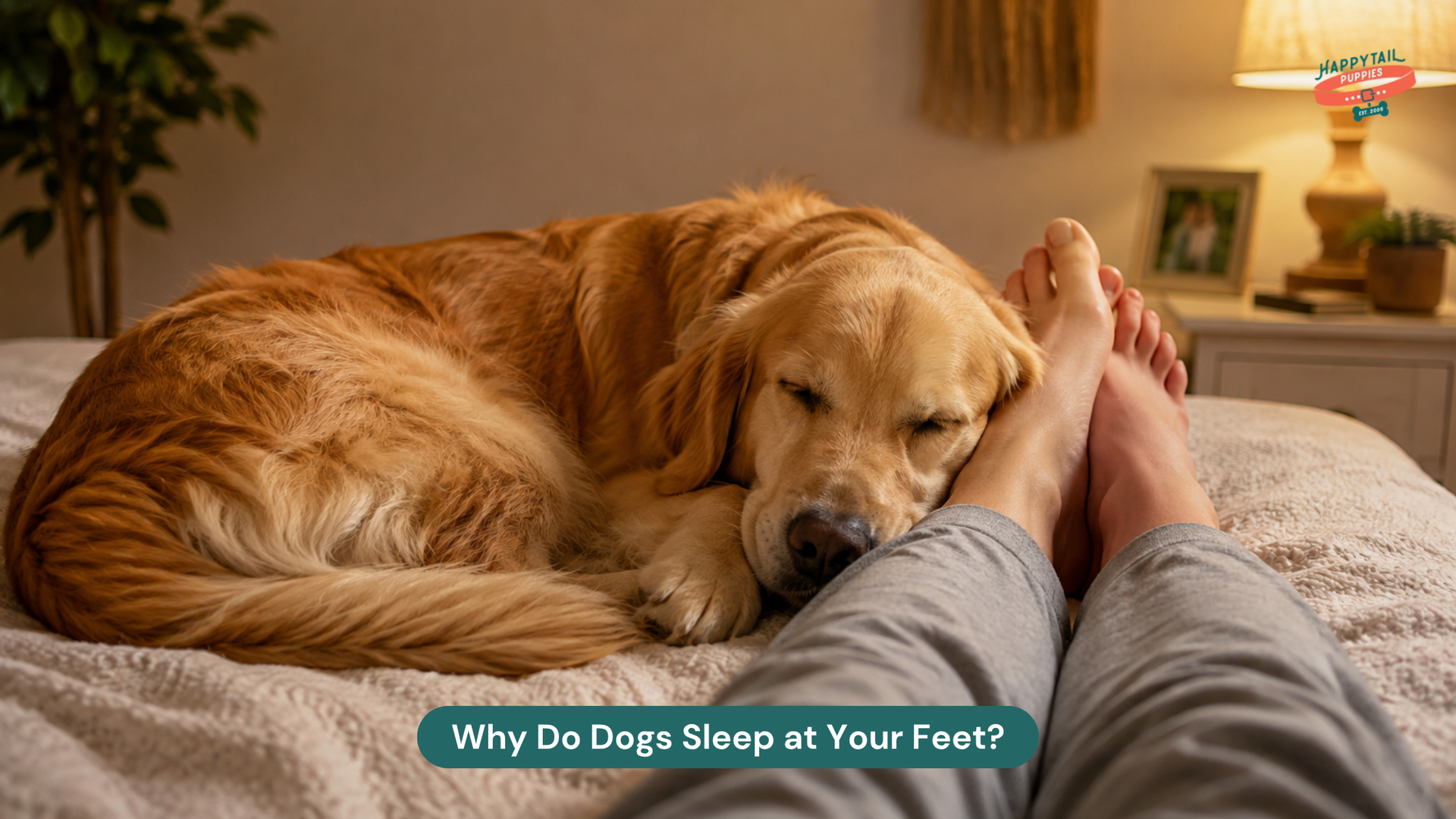
Your dog’s favorite spot at the foot of the bed is more than just a cozy place to sleep. Explore how scent, comfort, temperature, instinct, and trust all play a role in this adorable nightly habit.
⚡Quick Answer
Dogs often sleep at your feet because your scent makes them feel safe, being close to you satisfies their natural pack instincts, and the spot gives them a comfortable place to rest while staying near you. It’s a mix of comfort, companionship, and instinct—all curled up at the foot of the bed.
There’s a specific type of magic that happens the moment the lights turn out, and your pup decides exactly where tonight’s sleepover will happen. A small body circles twice under blankets, rustling, and then, thump, your feet become the coziest corner in the house.
Dogs are simply consistent little creatures. Once they find a routine, they fall in love with the foot-of-the-bed spot, and it turns into a nightly ritual fast enough. Also, a few dogs claim it the very first night home. While others take a couple of weeks to settle into their favorite groove near your ankles, the habit sticks, and it really sticks hard!
Even the tiniest breeds can get in on the action, and size never appears to matter. Especially for small dog breeds such as a Teacup Pomeranian pup who’s barely bigger than a rolled-up sock, it will still walk straight past a perfectly good dog bed only to burrow in near your feet.
So, let’s dig deeper to answer your question on “Why do dogs sleep at my feet?”
⚡At a Glance
- Your feet smell exactly like you
- Your feet mean safety and closeness to the pack
- Your feet can track movement, with guarding making sense
- Your feet remain cooler than the rest of the bed
- Your feet are submissive but still build a connection
Understanding Your Dog's Sleeping Behavior
Sleep position highlights more than just comfort. It represents instinct, scent, and trust. Dogs often read your bed the way they once understood their den.
Ancient Pack Instincts Still Run the Show
Even before memory foam existed, a dog’s ancestors used to sleep pressed together for warmth and protection. Such an instinct never faded. So, a pup near your feet is only operating on its ancestral instincts.
Your Scent Is Their Little Piece of Home
The nose of a pup is thousands of times more sensitive than ours, humans. Also, your feet hold a strong scent trail that you leave behind all day long. Such familiarity indicates safety, making your pup’s sleep extremely restful.
Temperature and Comfort Shape the Choice
Dogs are typically warmer compared to humans. So the foot of their bed feels a lot cooler and less tangled than the pillow zone. This type of airflow, along with strong contact, turns it into an easy spot to settle into.
The Science Behind Your Dog's Favorite Sleeping Spot
Your pup’s instincts all stack together to turn the foot of your bed the single most favorite spot in the house.
🐾 Your Scent Feels Like Home
Since nothing on earth will smell quite like home…
The nose of your dog is about ten thousand times more sensitive than a human’s. Your feet carry the strongest scent trail of the entire day. Such familiarity tells your dog that everything’s calm and safe.
Why your scent matters:
- Feet hold your strongest scent
- Familiar smell signals safety instantly
- Scent trail encourages easy sleep
Combined, such scents are signs your dog trusts you completely, as your feet feel like the most reassuring spot in the whole bed.
🐾 Pack Instincts Run Deep
Earlier, wolves slept close, and old habits stick around…
Wild canines normally rest in tight clusters for protection and warmth. Your bed plays the same role as an extremely plush den. Sleeping near your feet makes your pup feel connected without crowding your space.
How pack instinct shows up:
- Animals living in packs often rest close to each other
- Feet often feel a sense of contact instead of crowding
- Low spot continues building connection
This type of old pack wiring shapes where your dog will choose to curl up every single night.
🐾 Guard Duty Never Really Ends
There’s always someone who keeps a close watch on the door…
Your bed’s end offers a clear line of sight to the hallway, door, or windows. This makes it a prime lookout territory. Such a guarding instinct often runs quietly in the background even when your pup is fast asleep.
What the guard spot offers:
- Offers a clear sight of the rest of the home
- Identifies early warning signs of new sounds
- Watchful traits that linger long during sleep
Even when your pup is in their mid-dream, they quietly clock in for the night shift. This is a common dog body language that shows how safe they feel in your presence.
🐾 Feet Offer the Coolest Spot
Since nobody will enjoy sleeping in a sweaty blanket that works as a fort…
Dogs often have warmer bodies than humans. So, a cooler, less tangled corner of the bed feels extremely refreshing. Less blanket buildup near your feet means smoother airflow and an extremely comfortable night’s rest.
Why the cool spot wins:
- Feet are covered less by blanket, offering a cooler spot
- Cool air makes your pup comfortable
- Airflow can beat in trapped body heat
For a pup with a thick, dense coat, such a cooler pocket by your ankles offers them a pure sense of relief.
🐾 Body Heat Works Both Ways
Smaller breeds cherish your warm little anchor…
The desire for warmth is intensified in smaller and leaner breeds. Because of their thinner coats, they lose more heat during the night. Your feet begin to emit a strong, nice warmth that keeps the pups comfortable until morning.
How feet bring us warmth:
- Little dogs search for warmth
- Thin coats can help with heat-seeking behavior
- The feet will stay warm until morning
It’s rarely for such puppies that your feet are a location. Usually, they are a heat generator.
🐾 Trust Shows Up in Small Ways
The smallest of gestures are often the sweetest ones…
This says a lot in itself. Dogs often require big displays of devotion, but then echo back in a quiet spot close to your ankles. It becomes a reliable night-time choice that shows trust and helps form bonds.
How faith manifests each night:
- Do not underestimate the power of small gestures
- Trust shows if you motivate
- Your feet become a love letter each nigh
In reality, it is your dog’s quiet way of saying “GOODNIGHT”.
The American Veterinary Medical Association states that 80% of dog owners regard their dog as a full household member in America. That is why a slow, reassuring transition is better than an unexpected one.
Spotting the Signs Behind a Sudden Sleep Shift
A sudden change where your dog often slept at your feet has all of a sudden started avoiding the bed. It's worth checking in for dog owners. Most of the changes are harmless, but a couple of signs deserve a closer look.
These include:
- New sleeping spots can indicate issues such as dog joint discomfort
- A sudden avoidance needs a closer watch from dog owners
- Restlessness along with pacing up and down will need immediate attention
- Whining or panting overnight is something worth noting
- Sudden shifts often indicate smaller changes
The Recent data from the American Academy of Sleep Medicine shows that close to half of pet owners will share a bed with their pup. Therefore, a change in sleep arrangement often changes the entire dynamics of how a household will rest, not just your pup.
Helping Your Pup Settle Into Their Own Cozy Corner
It is completely normal to want your personal space back at night, and with a little practice, your dog can learn to love a spot of their own.
- Choose a bed in proximity to your room
- Incorporate a blanket that has your scent
- Reward a calm settle with a small treat
- Ensure the new location is kept warm and comfortable
- Be consistent by doing it every night
A Mini Sleep-Spot Experiment Must-Try
On the next quiet evening, observe where your dog settles first.
Now see if you could shift one variable, which might be a cooler mat near the new bed or a t-shirt of yours with your scent on it.
It is fun and surprisingly revealing to observe which place receives the highest number of votes.
Sweet Dreams, Faithful Feet
Next time your ankles feel the warmth of a cat, take a second to think about what really is going on. This spot is not just for naps. That refers to faith, comfort, intuition, and love, all curled into a small snoozing package. Most dogs have their own way of showing their affection, but for many, this silent nightly ritual is their clearest sign that you matter most.
The next time you find yourself carefully freeing your toes from your sleeping pooch, remember that you haven’t lost your legroom just yet. You have just been chosen once again as home.
Quick Frequently Asked Questions
Why does my dog sleep on my feet instead of next to my head?
Feet carry a strong, familiar scent and offer a clear view of the room, which feels safer and more grounding than curling up near a pillow.
Is it bad for my dog to sleep at the foot of the bed?
Not at all. Most dogs choose this spot happily and comfortably, and it rarely signals a problem unless paired with sudden behavior changes.
Does sleeping at my feet mean my dog loves me less than one who sleeps on my chest?
Absolutely not. Sleep position reflects comfort and instinct far more than affection level, so that a foot-sleeper can be every bit as devoted as a cuddler.
Will my dog's sleeping spot change as they get older?
Often, yes. Puppies, adult dogs, and seniors all have shifting comfort needs, so a favorite spot today might look different in a year.
Should I encourage my dog to sleep somewhere else?
Only if the current spot causes discomfort for either of you; otherwise, let your dog keep their favorite corner. They picked it for a reason, and that reason is almost always you.