Do Dogs Get Jealous? Understanding Pet Emotions
🐾Table of Contents
Dogs are very emotional creatures whose emotions often come as a surprise to many. The most controversial question amongst pet owners and researchers is: Do dogs get jealous? You have likely already guessed the answer, should you have ever petted another dog and then found the spouse between you.
The short version? Yes—dogs can show jealousy-like behavior. But the underlying reality is even more interesting: what we refer to as jealousy in dogs is a combination of feelings that are related to bonding, attention, and the need to guard resources.
We will simplify it in a real-world manner.
What Do We Really Mean by “Jealousy” in Dogs?
When people speak of their jealousy, we most likely refer to a multifaceted feeling of insecurity, comparison, and fear of losing somebody.
In dogs, it is not that mental experience. Dogs do not sit there and think that the other dog is getting more love than they are. Their responses are less conscious and more effective instead.
Scientists tend to define it as a harmony of:
- Resource guarding (defending something good, such as attention or a special person)
- Social bonding behavior
- Change in attention causing emotional arousal
Although it is not exactly the same as human jealousy, it behaves similarly enough that most experts believe the term "jealousy-like responses" can be used comfortably to characterize it.
What Does Jealousy Look Like in Dogs?
In case you share your home with a dog, you have likely observed some typical signs:
Interrupting Behavior
When dogs see the focus shift to another pet or person, they tend to push their way in, either physically or behaviorally. This can involve intervening between people, pushing hands, or barging into personal areas to get back attention. Certain breeds, such as the Cavapoo, are particularly known to exhibit this behavioral trait. They develop a very strong emotional attachment with their owners and are likely to hang around them all the time.
Such disruptions tend to be spontaneous, rather than organized, and immediate. They indicate the desire to restore social connectivity in most domestic contexts.
Attention Seeking Actions
Attention-seeking behaviors involve barking, whining, pawing, or carrying toys, where a dog may feel neglected when interacting with another. All these actions are supposed to help make people refocus their attention back on the dog in a hurry.
Such behaviors are usually supported inadvertently as the owners react. This teaches the dog that both vocal and concrete means are effective in capturing attention once again in social situations, over and over again.
Body Blocking
Body blocking is a habit where a dog wants to place itself between the owner and another pet or person. This physical strategy is a means of regaining focus and ensuring proximity.
Such behavior might seem controlling, but in reality, it is usually motivated by an emotional attachment and insecurity. Here, the dog seeks a social relationship that it prefers at that time.
Pushy Affection
Pushy affection is persistent nudging, leaning, or pawing at a time when a dog suspects that affection is being diverted. It is a means of insisting on social action here and now.
Ignoring such behavior tends to worsen when it is not addressed because dogs learn that sometimes more persistence can result in interaction. This strengthens the cycle of attention-seeking to their owners in their routine. For example, a Mini Bernedoodle may show heightened pushy affection due to its affectionate and people-oriented nature, especially in multi-person households.
Mild Agitation
Light agitation can be manifested as pacing, fidgeting, or low-level vocalization in situations where a dog feels less attention on its side in the interaction with another person. It tends to be subtle yet observable.
These cues reveal the level of discomfort instead of aggression, and the dog is disturbed and requires reassurance by being next to or by touching their owner.
Why Does This Happen?
In order to get a picture of the behavior of jealousy, we have to consider the emotional structure of the dogs.
Social Animals
Dogs are inherently social animals derived from pack-living ancestors. Their cohesion and focus on groups were essential to their survival and emotional well-being.
Due to this history, dogs are very responsive to social changes. The shifts in attention can elicit instant behavioral changes to revive intimacy and ensure perceived group attachment.
Humans Become Primary Bond
Domestic dogs usually bond with their human caregiver and entangle mainly with him or her as the core figure in their social life. This attachment is formed by the constant attention, love, and experience.
When the focus has been redirected, the dog will consider this as a momentary rupture. This causes actions that aim at restoring the closeness and the assurances of their key attachment person. This is also related to the everyday habit of why dogs follow their owners everywhere. It is mainly because they feel comfort, security, and emotional stability when staying close.
Why Does Your Dog Follow You Everywhere?
From loyalty and love to curiosity and anxiety, discover the real reasons behind your dog’s shadow-like behavior and what it means for your bond.
🐶 Find Out Why Your Dog Sticks by Your SideCompetition For Resources
Dogs value attention, affection, and social interaction as important social resources rather than food or toys. By sharing or dieting these resources, a competitive emotional response can be instigated.
This impression makes dogs behave in a manner that wins or recovers interest. It is particularly in a multi-pet household where socializing time must be shared by the various animals on a regular basis.
Is Jealousy in Dogs a Bad Thing?
Not necessarily. Slight traces of jealousy are very natural and usually tend to be only an indicator of close attachment.
Nevertheless, it can be problematic when:
- The dog turns violent toward other pets or individuals
- They express persistent nervousness when not the focus
- In the case of neglect, they end up developing destructive behaviors
In such instances, it has less to do with jealousy than with emotional insecurity or lack of coping skills.
Can Dogs Feel Complex Emotions Like Humans?
The current animal behavior studies postulate that dogs undergo various feelings and emotions, which include:
- Joy
- Fear
- Excitement
- Anxiety
- Attachment
It also becomes tricky when it touches on the subject of self-reflective feelings such as guilt, shame, and the jealousy of humankind. Dogs do not seem to think in the narrative way that humans do.
Rather, they live in the present moment, short-term, and contextualized emotions.
This means that your dog reacts when you hug someone, not because you feel replaced, but because you want its social relationship back.
Real-Life Example: The “third Wheel” Effect
Imagine this situation:
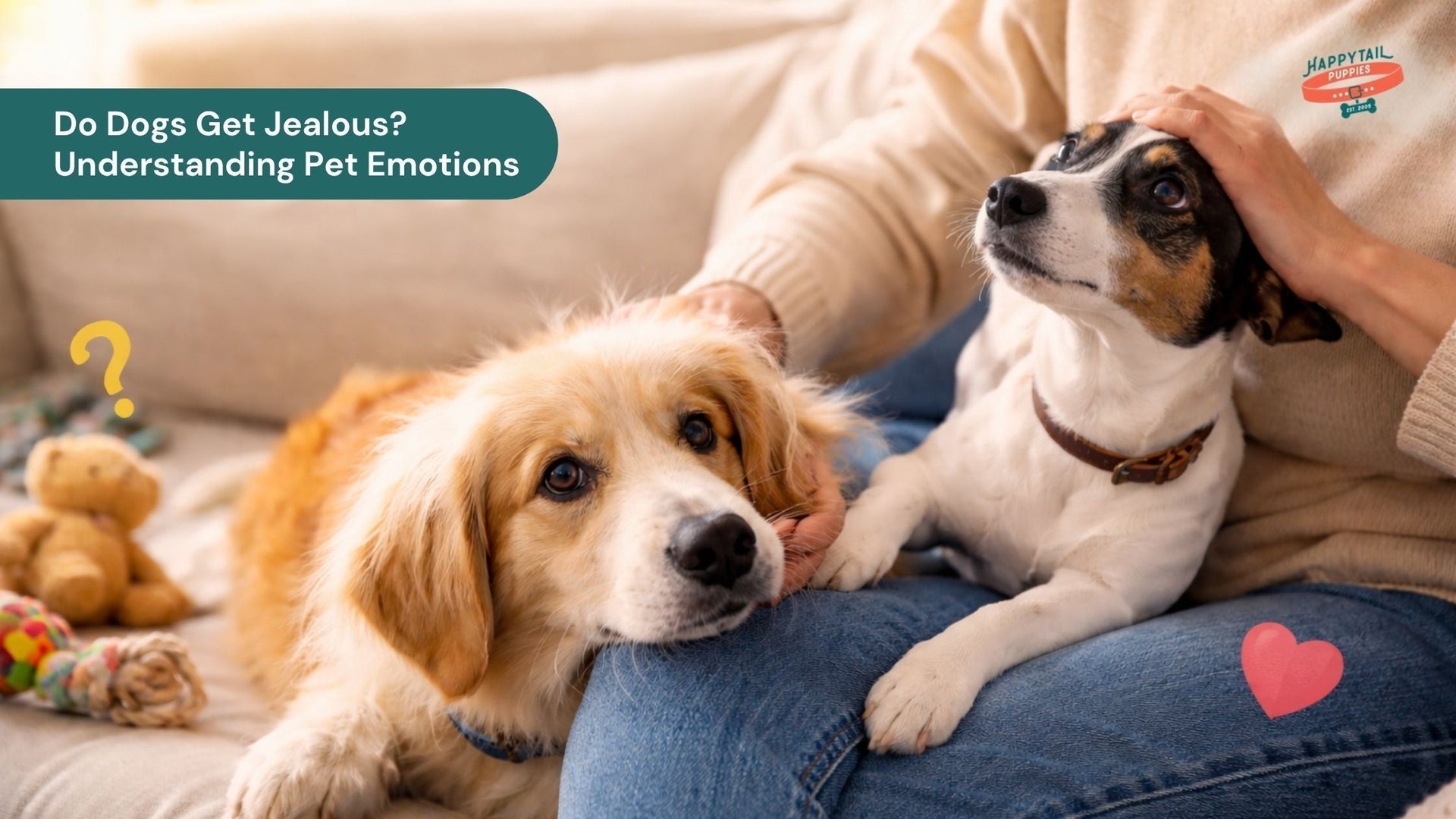
You are on the couch with your dog. Another pet jumps up, and you start petting it. Then all at once, your dog makes its way in, gets you by the hand, and perhaps even pushes away the other pet.
That’s a perfect example of jealousy-like behavior. It is not a strategic or planned competition. It is an emotional competition to capture your attention.
How To Handle Jealousy-Like Behavior In Dogs
The good news? With regular training and reassurance, you can control it and lessen it.
Reward Calm Behavior
The positive response to the calm and steady behavior of the dog will make their owner realize that the person can get a positive response and engage in a relaxing presence. This promotes emotional steadiness in mutual social conditions.
With repeated reinforcement of calm behavior, dogs tend to choose patient interactions as an alternative to demanding behavior, and unnecessary interruptions decrease as desired behavior is simplified in interactions, resulting in a more proportionate emotional reaction in everyday tasks.
Avoid Reinforcing Pushy Behavior
It is best to avoid the reinforcement of pushy behavior since there is a tendency to respond instantaneously to demanding actions. It is a way in which dogs learn that an interruption is an efficient way of attracting attention.
Owners can interrupt the chain of attention-seeking behavior and withhold a response. Only respond when the dog is calm. This intercepts the attention-seeking behavior and fosters more controlled and respectful social interaction patterns.
Teach Place Or Stay Commands
Teaching them to place and stay orders provides dogs with a definite action plan in distracted or divided attention situations. It makes them know where to stay still.
These orders develop impulse control and minimize reactive behaviors as they redirect the attention and enable the dogs to feel safe, even when shared attention among more than two people or pets.
Structured Attention Time
The time spent on structured attention helps to provide dogs with a steady and pre-warned interaction time. Furthermore, it helps reduce the risk of not knowing when they will have their owner's attention and engagement.
Such predictability will aid in diminishing anxiety-driven behavior. It is because dogs will understand that attention is not being lost but only being inserted at a specific time, thus providing a more stable overall emotional situation. It is here that the importance of dog training comes in, where regularly providing direction makes this dog realize its limits and its emotional appeals within its normal existence.
Early Socialization
Early socialization enables dogs to be used to shared attention and in a new environment, as well as other animals or people, when they are still young.
This exposure lowers the level of insecurity in later stages of life. As a result, the dogs are less prone to a strong reaction in cases where attention is split. Here, the dogs also tend to remain calm in a multi-pet environment or amongst social beings.
The Emotional Truth About Dogs
In the middle of it, it is not so much that dogs are reacting, but connecting.
Their social world is characterized by relationships. When such a linkage becomes threatened or diverted, they change their behavior in a manner that appears to be very similar to jealousy.
But below it, there is a thing that is less and more powerful:
They desire to be near those whom they trust
Final Thoughts
So, do dogs get jealous?
Yes, but not in the human, overthinking fashion. Instead, their interpretation is more direct, emotional, and impulsive. It is born out of love, attachment, and social complexities that make dogs such superior companions. Knowing this enables us to react patiently rather than frustratingly--and cement the relationship on each side.
Because in the end, what looks like jealousy is often just your dog saying one thing in the only way they know how:
“I still need you.”